Rental utilities: who pays what? (water, gas, electricity, service charge)
RentTab · Published: 28 June 2026
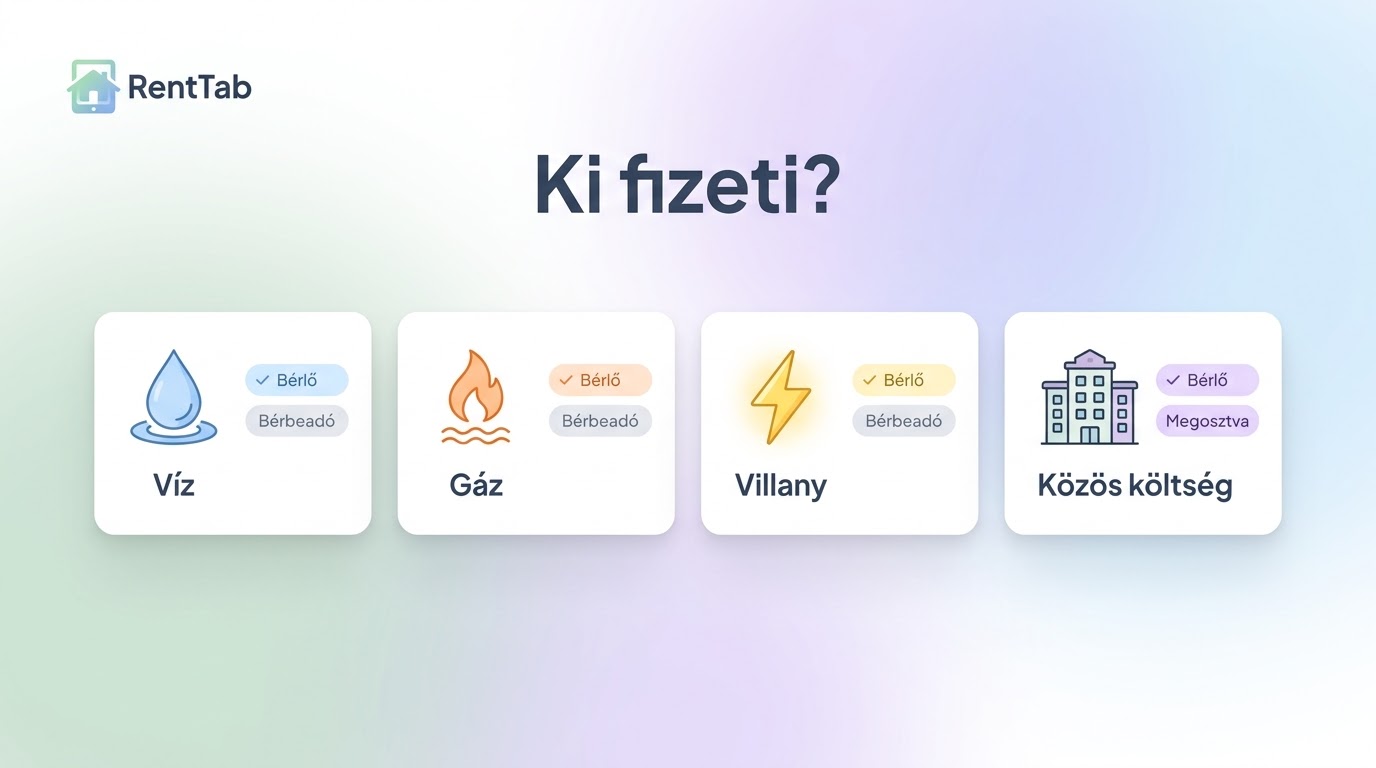
In a rental, the tenant usually pays the consumption-based utilities (water, gas, electricity), while the landlord typically pays the building service charge. But it’s a matter of agreement: the final split is set in the tenancy contract. Usage-based charges fall on the tenant; ownership/upkeep charges on the landlord. (The context is Hungarian; adapt to your market.)
This article goes through it line by line — who pays what, what’s customary, and what to put in writing so there’s no dispute.
The main rule: consumption vs. upkeep
The logic is simple:
- Consumption-based charges (depend on the tenant’s use) → tenant pays: water, gas, electricity, waste collection, internet.
- Upkeep / ownership charges (independent of use) → landlord pays: service charge, home insurance, property tax.
This is the “default” the parties can deviate from in the contract — but only if they record it in writing.
Line-by-line: who pays what?
| Charge | Who pays (usual) | Note |
|---|---|---|
| Electricity | Tenant | By meter |
| Gas | Tenant | By meter (monthly part-bill + annual reconciliation) |
| Water / sewage | Tenant | By meter; a submeter is more accurate |
| Waste collection | Tenant | Often a fixed fee |
| Internet / TV | Tenant | If in the tenant’s name; see below |
| Service charge | Landlord | Belongs to ownership (operation, renovation fund) |
| Home insurance | Landlord | Covers the property |
| Property tax | Landlord | Owner’s burden |
Who pays the service charge in a rental?
The service charge is paid by default by the landlord, because it attaches to ownership (running the building, the renovation fund). In practice two arrangements are common:
- The landlord pays and the rent already “includes” it — the cleaner option.
- The tenant reimburses the consumption-proportional part (e.g. water, if it’s inside the service charge) — this must be itemised.
The renovation fund and the operating part always stay with the owner — don’t pass those to the tenant.
Two settlement models
There are two established ways to handle utilities:
- By meter (actual): you read the meters monthly and charge actual consumption. Accurate, dispute-free, but takes admin.
- Flat rate (fixed): a fixed amount set in the contract. Simple, but if actual use differs, one side loses out.
The cleanest is metered settlement — covered in detail in utility bill settlement for rentals, A-Z.
Internet and TV: are they part of utilities?
Internet/TV isn’t a classic utility. Two cases:
- In the tenant’s name → they pay directly; it’s not part of the utility settlement.
- In the landlord’s name → build the fee into the rent or the flat rate, and record it.
The point: leave no grey zone — the contract should say whose it is.
What to put in the contract?
90% of disputes come from the split not being written down. Cover in the contract:
- which charge each party pays (per the table above),
- metered or flat-rate settlement,
- the meter readings at move-in for every meter,
- the deadline for payment and reconciliation.
The move-in meter reading is critical — without it you can’t settle accurately at move-out, and even the deposit return becomes contentious.
Where RentTab helps
RentTab records per property who pays which charge, logs the meter readings, and produces an itemised utility settlement at month-end — so “who pays what?” is decided once and tracked automatically every month. RentTab doesn’t handle money; it supports the records and the settlement.
Frequently asked questions
Who pays the utilities in a rental? The consumption-based charges (water, gas, electricity) are usually the tenant’s, by actual use. The service charge and insurance are usually the landlord’s.
Who pays the service charge in a rental? By default the landlord, because it attaches to ownership. The parties can agree to pass on the consumption-proportional part if the contract records it.
Are utilities included in the rent? Only if the contract says so (flat-rate model). Otherwise utilities are payable on top of the rent, by consumption.
Who pays the water bill if there’s no submeter? Without a submeter, consumption is estimated or split via the service charge — settle this in the contract. A submeter makes the settlement accurate.
What if the tenant doesn’t pay the utilities? The debt can be settled from the deposit at the move-out reconciliation, if the contract and the meter readings support it.