Utility bill settlement for rentals, A-Z: the complete landlord guide
RentTab · Published: 21 June 2026
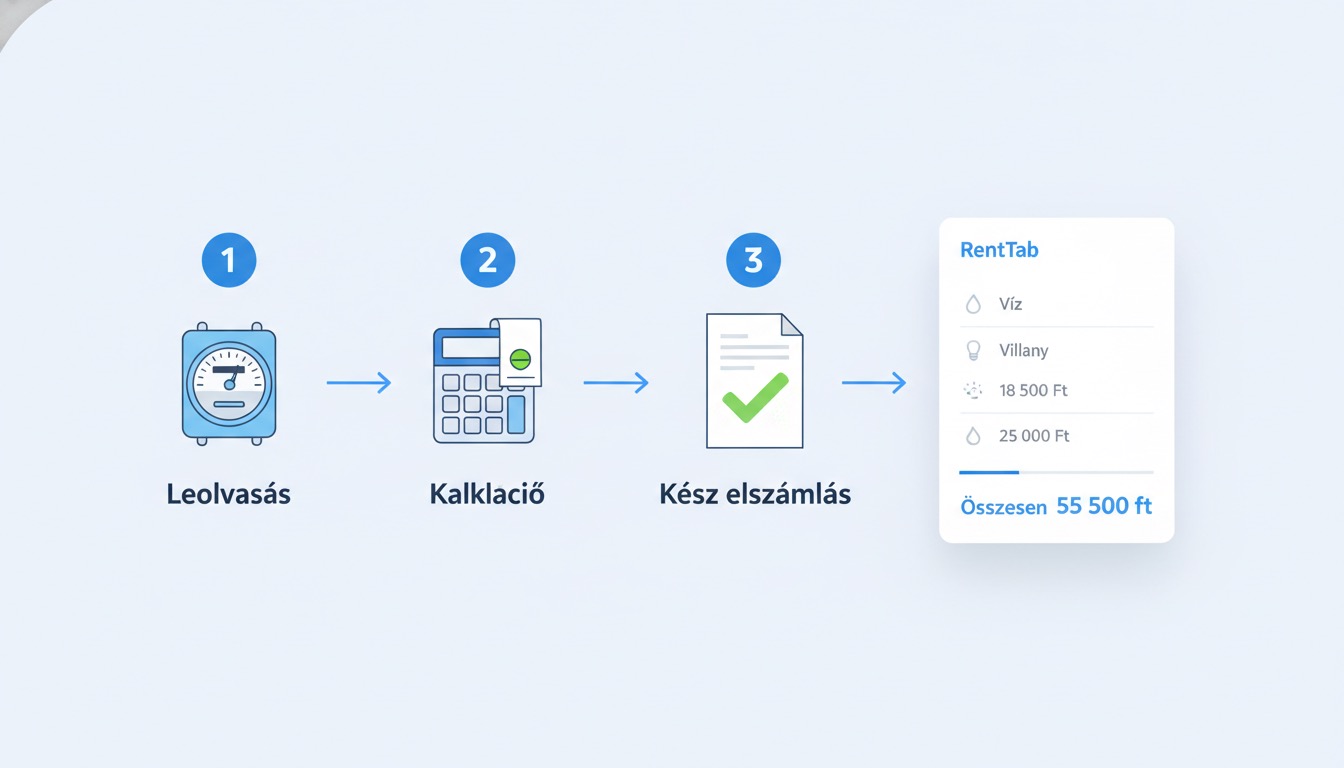
Utility settlement for a rental means the landlord bills the tenant based on actual consumption: read the meters, calculate the period’s usage, add the standing charges, and total it all in a clear statement covering water, electricity, gas and other charges. The key to a fair settlement is a documented meter reading and a consistent method.
This article walks through the whole process — from the first meter reading to the finished statement — with a worked example and the most common mistakes to avoid. If you rent out one or two flats, keep this as your monthly reference.
What counts as a utility charge, and what doesn’t?
Most confusion starts here, so let’s separate the amounts a tenant pays into three groups:
- Rent — paid for the use of the flat. This is NOT a utility charge.
- Metered charges — water, electricity, gas, district heating. Billed from meter readings.
- Non-metered (flat) charges — building common cost, waste fee, possibly internet. Fixed amounts.
In RentTab, metered and non-metered charges are deliberately kept separate, because they’re settled completely differently. For metered charges you calculate consumption; for non-metered ones you simply pass on a fixed amount.
Who pays the utilities in a rental?
The general rule is simple: consumption-based charges are paid by the tenant, since they use the flat. In practice the contract decides — so for every charge, record in writing who bears it. The most common split:
| Charge | Usually paid by | How |
|---|---|---|
| Water | Tenant | by meter |
| Electricity | Tenant | by meter |
| Gas | Tenant | by meter |
| Common cost | Varies (per contract) | fixed |
| Waste fee | Tenant | fixed |
| Renovation fund | Landlord | — |
We touch on this in Renting without spreadsheets too — the point is that responsibility is unambiguous for every item before the tenant moves in.
Utility settlement step by step
Step 1 — Record the move-in reading (the baseline)
Settlement is dispute-free only if you know exactly where you started. At move-in, record a starting reading for every meter, with a date and a photo:
- water meter(s) — cold and hot separately if applicable,
- electricity meter — if dual-tariff (day/night), both registers,
- gas meter.
This starting value is the basis of your first settlement. Never start a tenancy without the photo — at move-out it’s your evidence.
Step 2 — Read the period-end meters
At the end of the settlement period (usually monthly or quarterly) read the same meters again. Consumption is a simple subtraction:
Consumption = closing reading − opening reading
For example, if the electricity meter opened at 12,500 kWh and closed at 12,800 kWh, the period consumption is 300 kWh. Always read the same meter the same way.
Step 3 — Convert consumption to money
The meter measures in its own unit (kWh, m³); the bill is made of charges. The total has two parts:
Amount due = (consumption × unit price) + standing charge
- Unit price — the charge per unit of consumption (per kWh, per m³), shown on your provider’s bill.
- Standing charge — a fixed monthly item, independent of consumption.
Gas has one extra step: the meter measures in m³ but the bill is kWh-based. To convert, use the correction factor and calorific value shown on the bill. At settlement, the provider’s bill is the authoritative source.
Step 4 — Add the non-metered charges
Add the fixed items to the consumption: common cost (if it falls on the tenant), waste fee, and anything else the contract assigns to the tenant. These aren’t calculated from readings — they’re simply added to the statement.
Step 5 — Build the finished statement
The final step is a clear, itemised statement the tenant can understand. A good settlement includes:
- the period (from–to),
- opening and closing readings per meter,
- consumption and unit price,
- standing charges and non-metered items,
- the grand total.
Worked example: one monthly settlement, A-Z
A simple, round example for one month:
| Item | Opening | Closing | Consumption | Unit price | Standing | Total |
|---|---|---|---|---|---|---|
| Electricity | 12,500 kWh | 12,800 kWh | 300 kWh | 40 / kWh | 1,500 | 13,500 |
| Water | 220 m³ | 225 m³ | 5 m³ | 700 / m³ | 800 | 4,300 |
| Gas | — | — | (per bill) | — | — | 5,200 |
| Waste fee | — | — | — | — | fixed | 1,000 |
| Total | 24,000 |
The tenant sees exactly what makes up the total — and behind every line is the recorded reading and the provider’s unit price. That’s the secret to a dispute-free settlement.
The 4 most common mistakes (and how to avoid them)
- No starting reading. Without a photo and date, move-out becomes one word against another. Always record it at move-in.
- Estimated reading instead of actual. Estimated values diverge from real consumption and easily cause over- or underpayment. Always use the read value.
- Missing or double-counting the standing charge. It’s fixed; don’t forget it, but don’t count it twice.
- Inconsistent method. If you calculate differently each month, the tenant can’t follow. Use one fixed method and template for the whole tenancy.
How RentTab helps
Done manually, the process above takes 15–30 minutes per flat per month, with a chance to mistype at every step. RentTab automates it: the tenant photographs the meter with one tap, the value is read out, consumption and charges are calculated automatically, and you get a finished, itemised statement the tenant can follow. RentTab does not accept or handle money; it produces and records the settlement. To simplify the rest of your monthly admin, see renting without spreadsheets. And for the full year of deadlines, see the rental admin annual calendar.
Frequently asked questions
Settle monthly or quarterly? However your contract sets it. Many landlords read monthly, because each settlement carries less error and is easier to follow.
What if the tenant disputes the consumption? That’s why you keep a dated photo reading for every period. The read value plus the provider’s unit price justify every line.
Does the tenant or the landlord pay the common cost? It depends on the contract. Record in writing before move-in who bears it.
Does utility billing count as the landlord’s taxable income? Charges passed on at actual consumption generally don’t; rent does. Always verify the current rule with your tax authority.