Rental admin: the complete annual calendar for landlords
RentTab · Published: 21 June 2026
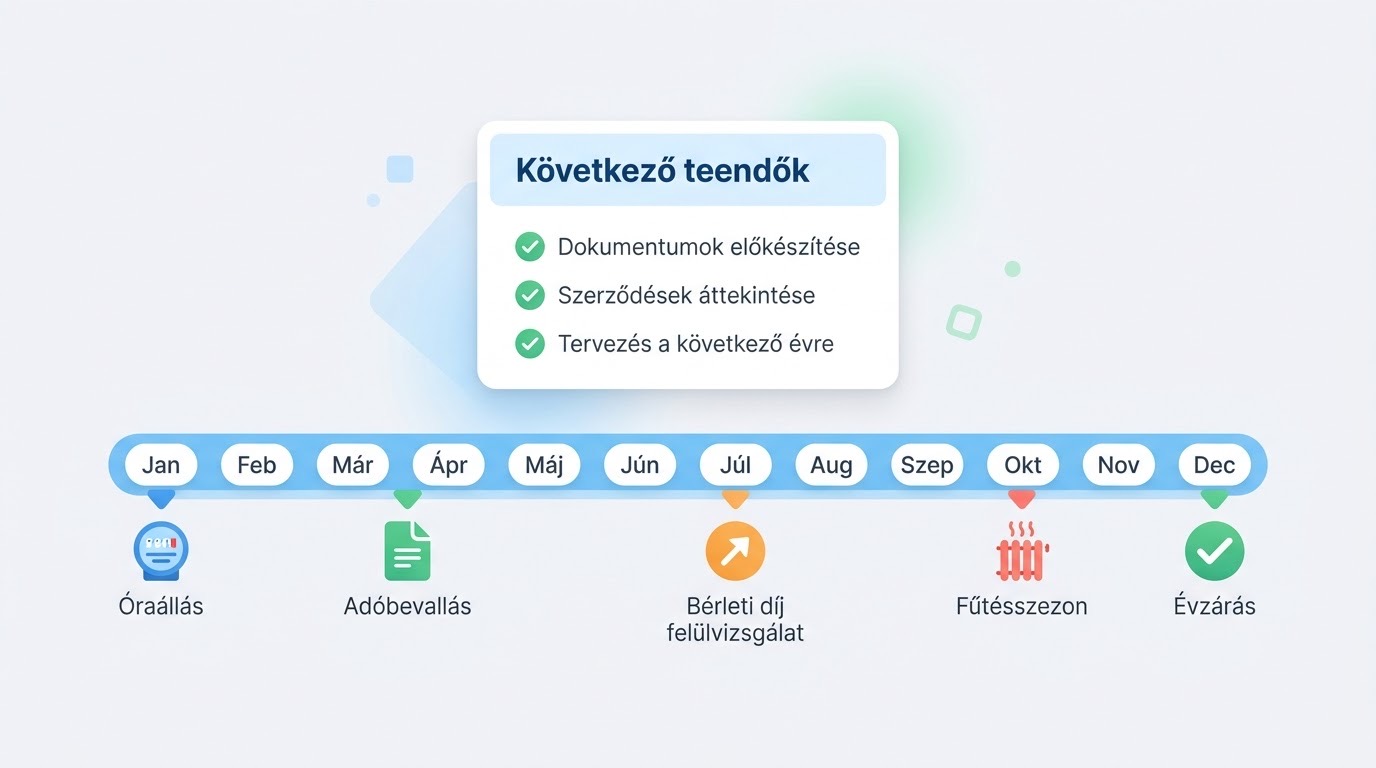
Rental admin comes in four recurring blocks: monthly tasks (meter reading, settlement, collecting rent), annual tasks (tax return, contract review, rent increase), seasonal tasks (start and end of the heating season), and ad-hoc tasks (tenant change, repairs). Organise these into one calendar and no deadline slips — and there are no surprises at move-out.
This article gives you a ready annual calendar: month by month, what’s worth handling for a let property. For one or two flats, pin it up; for several, set it as reminders.
The four task types
Before the calendar, it helps to separate why each item lands there:
- Monthly, recurring: meter reading, settlement with the tenant, checking that rent arrived.
- Annual, fixed-date: tax return, contract and rent review, insurance renewal.
- Seasonal: start of the heating season (autumn) and its end (spring), summer peak usage.
- Ad-hoc: tenant change, repair reports, deposit settlement. These can’t be scheduled ahead, but you should have a protocol for them.
The annual calendar, month by month
Dates are indicative — adjust to your contract’s anniversary and your providers’ reading deadlines. The tax dates below follow the Hungarian system; check your own jurisdiction.
| Month | Main task |
|---|---|
| January | Year-turn reading on every meter; close last year’s final settlement. |
| February | Prepare the tax return: total the year’s rent and charges. |
| March | Spring condition check; contract anniversary near? Rent review. |
| April | File the tax return (the personal annual return deadline is typically 20 May in Hungary — always confirm with the current tax-authority guidance). |
| May | Finalise the return; prepare for summer. |
| June | Half-year review: did every tenant pay? Handle arrears. |
| July | Watch summer peak usage (water, cooling); availability during holidays. |
| August | Prepare contract renewals for autumn anniversaries. |
| September | Before the heating season: boiler/heating check, reading at season start. |
| October | Heating season begins; gas usage rises — read precisely. |
| November | Plan year-end tasks; review contracts for next year. |
| December | Year-end: 31 December reading on every meter, annual settlement, announce next-year rent increase if warranted. |
The monthly routine (the same every month)
Alongside the annual dates there’s a core that repeats every month:
- Meter reading — the tenant reads (or photographs) the meters, you record them.
- Settlement — calculate consumption and charges, send the itemised statement. For the full process, see utility bill settlement for rentals, A-Z.
- Collection check — did rent and utilities arrive? On arrears, send an immediate written reminder.
Done by hand, these three steps take 15–30 minutes per flat per month — and that’s exactly what RentTab automates: readings come from a photo, charges are calculated for you, payment status shows in one view. RentTab does not handle money; it produces and records the settlement.
Ad-hoc tasks: have a protocol
For what can’t be scheduled, prepare a script in advance:
- Tenant change — key overlap, readings between old and new tenant, deposit settlement.
- Repair reports — one channel where the tenant flags issues, with a record of who fixes what and when.
- Deposit settlement — at move-out, reconcile against the move-in condition photos.
To simplify the whole of your monthly admin, see renting without spreadsheets.
How to set up your own calendar
- Write down the fixed dates: contract anniversary, tax-return deadline, provider reading deadlines.
- Add the monthly routine as a recurring reminder (reading → settlement → collection check).
- Mark the seasonal points: start of the heating season (September), its end (spring), summer peak.
- Build an ad-hoc protocol for tenant change, repairs and deposits — so you don’t improvise from memory.
Frequently asked questions
When is the tax-return deadline for landlords? The personal annual return deadline is typically 20 May in Hungary. Always confirm the current date with the tax authority.
Should I read meters monthly or less often? Many landlords read monthly because each settlement carries less error. Your contract and provider reading schedule decide.
When can I announce a rent increase? Typically tied to the contract anniversary or year-end, in the manner set out in the contract and with prior notice.
What’s the most important date of the year? The 31 December (year-turn) reading on every meter — it’s the basis of every annual settlement.