Hungarian rental prices Q3 2026: a July peak, then a September dip
RentTab · Published: 20 October 2026
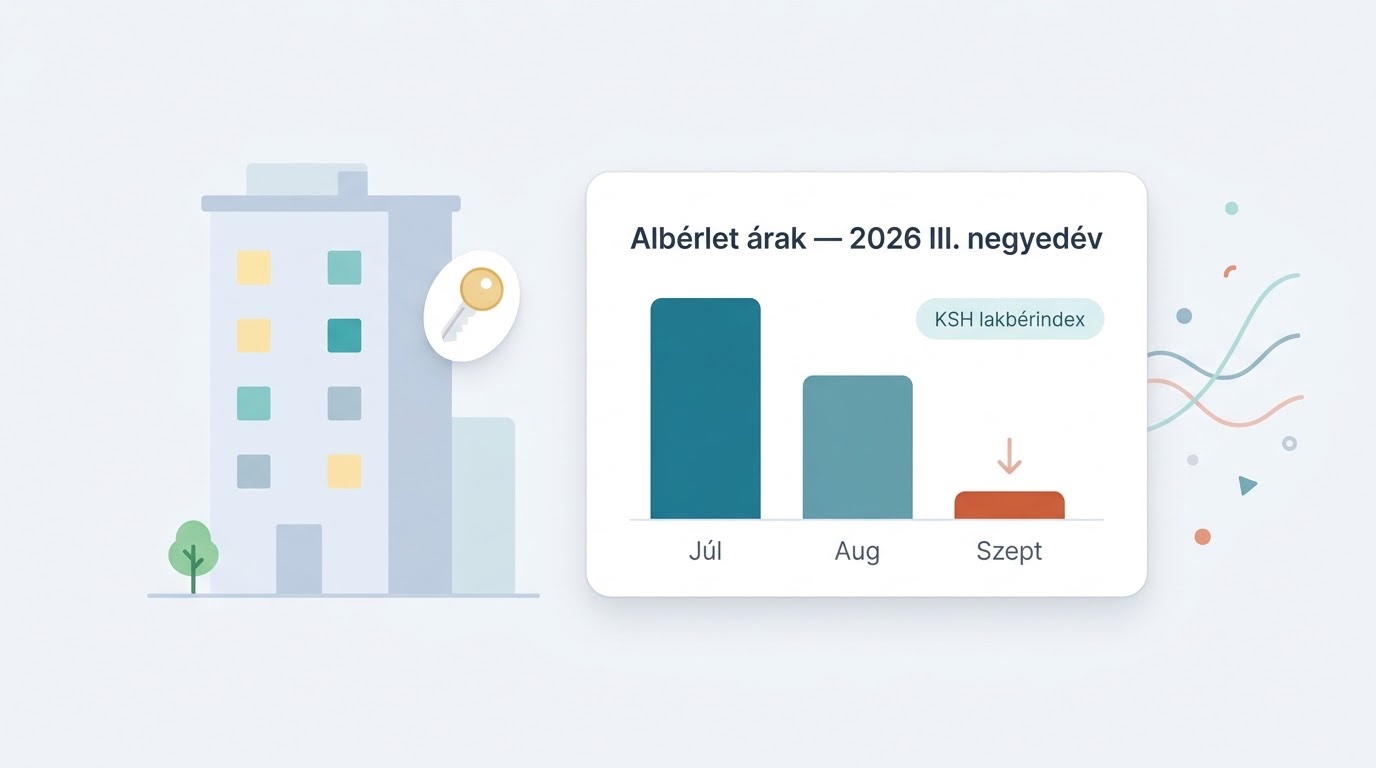
Hungarian rents climbed to their usual summer peak in Q3 2026, then dipped slightly in September. According to the KSH–ingatlan.com rent index, asking rents changed by +1.6% in July, +0.7% in August and −0.2% in September nationally. Over the whole quarter rents rose roughly 2.1% nationally and 2.5% in Budapest, and in September they were still 6.0% higher than a year earlier.
Data source: the July, August and September releases of the KSH–ingatlan.com rent index (asking rents in listings). Forint rent levels and listing counts come from ingatlan.com listing data. The quarterly total is our own calculation from the monthly indices. The data is Hungarian; adapt the takeaways to your own market.
Monthly rent changes, July–September 2026
Monthly rent change, Q3 2026
Asking rents, change vs. previous month (%) — KSH–ingatlan.com rent index
| Month | Monthly change (Hungary / Budapest) | Annual change (Hungary / Budapest) | What happened |
|---|---|---|---|
| July | +1.6% / +1.7% | +5.5% / +5.0% | Seasonal peak: university admissions, summer moves |
| August | +0.7% / +0.9% | +5.0% / +5.2% | Slowdown as supply grew |
| September | −0.2% / −0.1% | +6.0% / +5.3% | Slight decline in most regions |
| Q3 total | ≈ +2.1% / +2.5% | — | Calculated from the monthly indices |
In September, rents were 77–78% above their 2021 base level. Real rents (adjusted for inflation) were 4.3% higher nationally and 3.7% higher in Budapest than a year earlier, so rents are still outpacing general inflation.
Why did rents fall in September?
A −0.2% move looks small, but it is unusual: rents rarely fall at the start of the academic year. Two things explain it:
- The summer spike didn’t hold. According to ingatlan.com, the typical Budapest asking rent was about HUF 260,000 in early July. It jumped to HUF 266,500 around the university admission results, then fell back to HUF 260,000 by early August. Demand was weaker than in previous years.
- Supply shrank, but it wasn’t in control. In early October just over 15,000 rentals were listed on ingatlan.com nationwide: 5.3% fewer than a month earlier, 11.9% fewer than a year earlier, and the lowest level in two years. Shrinking supply would normally push rents up, so the dip points to soft demand.
Why did the annual rate rise in September (5.0% → 6.0%)? It’s a base effect: the drop in September 2025 was larger, so this year’s milder dip produces a higher year-on-year figure. It does not mean rent growth is accelerating again.
Budapest rents by district
KSH district-group data shows the largest annual increase in September in the Buda hills (+7.4%) and the smallest in inner Pest (+3.7%). Month on month, only Buda saw rising rents in September, while all three Pest groups declined (between −0.4% and −0.8%).
In forints (ingatlan.com median, early October 2026):
- Budapest overall: about HUF 260,000/month, unchanged from a year ago
- Most expensive: districts II and V, about HUF 350,000/month
- Cheapest: districts XX and XXI, about HUF 200,000/month
Rents in other Hungarian cities
Among the large cities, Debrecen is the most expensive (about HUF 220,000/month in early October, HUF 10,000 less than a year earlier). In early August, typical rents were about HUF 210,000 in Szeged, HUF 200,000 in Győr and Székesfehérvár, HUF 180,000 in Pécs and HUF 130,000 in Miskolc. The cheapest county seats (Békéscsaba, Szekszárd) were around HUF 120,000. Supply fell even faster in county seats than in Budapest: 16.6% fewer listings year on year by October.
What it means for landlords
- “You can always raise rents in summer” no longer holds. The July gain melted away by August, and asking rents fell in September. Price a new tenancy against current local listings, not the summer peak.
- A good existing tenant is worth more. With softer demand, an empty month costs more than a skipped increase: one vacant month wipes out roughly 8% of a year’s rental income.
- For increases, the 4–6% annual market pace and your lease’s indexation clause are sensible anchors. Your real return depends on rent, charges and occupancy together; see our rental yield calculation guide.
- Keep utilities separate and transparent. When tenants can see the full housing cost, a justified rent increase is easier to accept. More in utility bill settlement for rentals.
For the longer view, see Hungarian rental price history 2016–2026 and rental price trends in the first half of 2026.
Where RentTab helps
RentTab is a rental management and utility settlement app for landlords. It records rent, charges and utilities per property and tracks payment status. The market index tells you where the market is heading; RentTab shows what your own properties actually earn, based on your data rather than estimates.
Frequently asked questions
Are rents falling in Hungary in 2026? They dipped slightly in September (−0.2% nationally, −0.1% in Budapest month on month), but were still 6.0% and 5.3% higher year on year (KSH–ingatlan.com rent index). One month is not a lasting decline.
How much did rents rise in Q3 2026? Calculated from the monthly indices, about 2.1% nationally and 2.5% in Budapest between July and September, almost all of it in July.
How much does it cost to rent in Budapest? According to ingatlan.com, the Budapest median rent was about HUF 260,000/month in early October 2026: about HUF 350,000 in districts II and V and about HUF 200,000 in districts XX and XXI.
Why are there so few rentals on the market? About 15,000 rentals were listed in early October, the lowest in two years (−11.9% year on year). Analysts point to slowing house-price growth and falling rental yields, which make buy-to-let less attractive.
When is the next rent index release? KSH is expected to publish the October 2026 data on 12 November 2026.
Sources
- KSH–ingatlan.com rent index, July 2026 — ksh.hu
- KSH–ingatlan.com rent index, August 2026 — ksh.hu
- KSH–ingatlan.com rent index, September 2026 — ksh.hu
- Rents rose in July but growth stalled (ingatlan.com data, August 2026) — origo.hu
- Rents falling, supply at two-year low (ingatlan.com data, October 2026) — hellomagyar.hu